
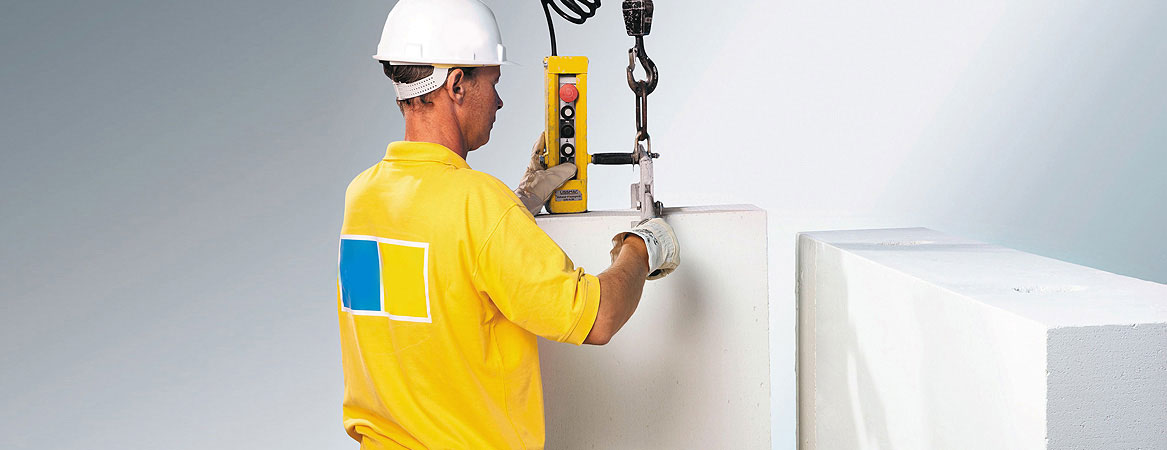
AAC blocks are the new favourite building material of the construction industry
These blocks are lightweight, energy-efficient, fire-resistant and an excellent thermal insulator. The blocks are extremely lightweight and thus suitable for internal as well as external construction.
Aerated concrete blocks are ideal for all kind of structures such as schools, hospitals, hotels, offices, independent housing and apartments. The buildings constructed with AAC blocks are also known as environmentally friendly buildings and these buildings don't require curing and plastering.
AAC was developed in 1924 by a Swedish architect, who was looking for an alternate building material with properties similar to that of wood - good thermal insulation, solid structure and easy to work with.
Autoclaved Aerated Concrete blocks are manufactured by recycling fly-ash. Fly ash is mixed with cement, lime, water and an aerating agent.

It is four times lighter than traditional bricks.
Reduces operating costs and overall construction costs.
Non-combustible & can withstand 6 hours of direct heat exposure.
Excellent acoustic insulation.
High dimensional accuracy, available in exact sizes. Requires no thick set mortar.
Reduces construction time by 20%. Easy to install. Constructing with AAC is very rapid
Low thermal conductivity of AAC blocks ensure better thermal energy efficiency.
Durable, high compressive strength & termite resistant. Requires no plastering or curing.
The water absorption of AAC blocks is relatively lower than others.
Light weight AAC blocks reduces the impact of an earthquake on a building.
Manufactured using recyclable industrial waste material named fly ash.
Manufactured as per BIS Norms.
Excellent thermal insulation. Higher savings on heating and cooling costs.
Blocks can be easily cut, drilled, nailed, milled & grooved. Excellent size/weight ratio.
| Parameter | MEPCRETE AAC Block | Concrete Block | Clay Brick |
| Size (mm) | (600x200x100-300) | (400x200x100-200) | (230x115x75) |
| Variation in dimensions | +/-1mm | +/-3mm | +/-5mm |
| Compressive strength | 30 - 50 kg/cm2 | 40 - 50 kg/cm2 | 25 - 30 kg/cm2 |
| Dry Density | 550 - 700 kg/m3 | 1800 kg/m3 | 1950 Kg/m3 |
| Fire Resistance | 4 - 6 Hour’s Depending on thickness |
4 hours | 2 hour |
| Sound Reduction Index (dB) | 60 for 200 mm thick wall | 30 for 200 mm thick wall | 40 for 230 mm thick wall |
| Thermal Conductivity W/(K-m) |
0.122 | 0.51 | 0.81 |

When AAC is mixed and cast in forms, several chemical reactions take place that give AAC its light weight and thermal properties. Aluminium powder reacts with calcium hydroxide and water to form hydrogen. The hydrogen gas foams and doubles the volume of the raw mix creating gas bubbles up to 3mm in diameter. At the end of the foaming process, the hydrogen escapes into the atmosphere and is replaced by air.
This process requires 30% less energy compared to clay brick manufacturing.When the forms are removed from the material, it is solid but still soft. It is then cut into either blocks or panels, and placed in an autoclave chamber for 12 hours. Because of the relatively low temperature used AAC blocks are not considered fired brick but a lightweight concrete masonry unit. After the autoclaving process, the material is ready for immediate use on the construction site.